BY: JENNIFER PEACE FOR: EAUSTON SOLUTIONS AND PROPERTIES
INTRODUCTION
The real estate industry is inherently growth-driven. Growth entails the drive to expand, to scale a business to the level of carrying out more projects, servicing more clients, amassing higher profits, and stronger investor participation. Potentially, it is every business’s goal to grow exponentially as growth leads to more revenue and brand power, increased investor and client confidence, and market influence. However, history has shown that unchecked growth, especially in real estate, can expose companies to legal disputes, financial instability, reputational damage, and operational collapse. Sustainable success is no longer defined by how fast a company grows, but by how responsibly and transparently that growth is managed. This is where Governance comes in.
Governance, on the other hand, refers to the systems, rules, and ethical standards that ensure responsible, compliant, and sustainable operations within a company. Governance is the system of rules, practices, and processes by which a company is directed and controlled. It involves balancing the interests of a company's many stakeholders, such as shareholders, management, customers, suppliers, financiers, government, and the community. For a real estate business, it creates the structure that ensures every deal, project, and partnership is handled with integrity, transparency, and foresight. Good governance leads to investor and buyer trust, the Protection of the company from legal and reputational damage, which further enables long-term stability and sustainability.
It is important to find a middle ground regarding how a real estate company can grow aggressively without compromising integrity, compliance, and quality, because in real estate, where transactions are capital-intensive and legally complex, growth without structure can be dangerous. This involves moving from a "Founder-led" model to a "Process-led" model, the evidence of which will be visible in how the business is structured, how decisions are made, and how expansion is executed in practice.
The Core Challenge: Growth Versus Governance
Real estate companies often face tension between:
- The need to act quickly to secure land, funds, or market opportunities, and
- The need to conduct due diligence, obtain approvals, and follow internal controls
When growth is prioritized at the expense of governance, companies risk:
- Selling properties without verified titles
- Overleveraging through poorly structured financing
- Misrepresentation in marketing and sales
- Weak internal controls and financial opacity
Nevertheless, excessive bureaucracy and rigid controls can slow decision-making and cause missed opportunities. The objective is not to choose one over the other, but to integrate governance into growth strategies.
What balancing growth and governance would look like in a real estate company.
- Strategic Growth Guided by Governance
As a firm grows, decision-making must shift from individual intuition to collective deliberation. This is done by the creation of a Strong Leadership structure with clear Oversight. Investors need the assurance that their funds are secure and used appropriately, and one way to ensure that confidence is the presence of a board. The company pursues expansion (new estates, cities, or asset classes) only after structured approval by the board. Growth targets are tied to risk assessments, legal feasibility, and capital capacity. This will lead to Growth that is deliberate and scalable, not impulsive or opportunistic. Expansion decisions will be documented, justified, and aligned with long-term strategy by the board.
Growth guided by governance would entail:
- Having A Board of Directors or Advisory Board that provides oversight on major investments, land acquisitions, and funding decisions.
- Management (CEO/MD and executives) focusing on execution, not unchecked authority.
- Making Key decisions requires dual approval at all times.
This preserves the entrepreneurial drive and desire for growth and expansion in the company, but with checks and balances that prevent excess risk or abuse.
- Controlled Financial Governance and Growth
Controlled financial growth addresses one of the most dangerous temptations in real estate: overleveraging and overextension driven by the illusion of abundant opportunity. Multiple land acquisition opportunities become available, several projects show promising returns, and investors are willing to commit capital. The temptation is to pursue everything simultaneously, and this approach frequently leads to disaster.
Uncontrolled financial growth manifests in several ways: taking on more projects than available capital can adequately fund, forcing the company to choose between completing existing projects poorly or abandoning them mid-construction; borrowing more money than you are sure the company can pay back, leaving the company vulnerable when markets soften or sales slow.
Controlled growth would mean expanding at a pace your financial resources can sustain, with deliberate constraints that prevent overextension.
Controlled Financial growth will entail:
- The company raising capital (equity, joint ventures, or debt) responsibly with clear use-of-funds disclosures supervised by A Capital Allocation Committee.
- Financial statements are being prepared regularly and audited to provide investors with transparent updates on project progress, capital deployment, and returns.
- Projects are being launched only when funding structures and cash-flow projections are sound.
- Maintaining liquidity buffers for unexpected challenges.
This will result in the business growing without overleveraging, investor disputes, or financial opacity. The companies that survive and thrive through multiple cycles are those that maintain financial discipline even when growth opportunities appear abundant.
- Regulatory Compliance
In Nigeria, real estate companies operate within a complex regulatory environment involving multiple agencies at the federal and state levels. For companies engaged in property development, sales, and investment schemes, key regulatory relationships include the Securities and Exchange Commission for investment products, the Corporate Affairs Commission for corporate compliance, state physical planning authorities for development approvals, tax authorities at the federal and state levels, and anti-money laundering agencies for financial crime prevention.
Effective governance means treating compliance not as an afterthought but as a core operational requirement.
This involves several elements, such as:
- Maintaining current knowledge of applicable regulations and how they apply to specific business activities.
- Securing all required registrations and licenses before commencing regulated activities.
- Implementing internal policies and procedures that ensure ongoing compliance.
- Conducting periodic compliance audits to identify and rectify gaps.
- Training staff on compliance requirements relevant to their functions.
Companies that view compliance as merely avoiding punishment miss the strategic opportunity, and those that embed compliance into their operational DNA gain a competitive advantage.
- Ethical and Compliant Land Acquisition
Ethical and compliant land acquisition is the foundation upon which sustainable real estate growth is built. Because land is a finite, high-value asset governed by complex legal, social, and regulatory frameworks, the manner in which a real estate company acquires land directly affects its legal standing, reputation, and long-term viability. In a growth-oriented environment, the pressure to secure land quickly can tempt companies to bypass due process. However, responsible real estate firms recognize that speed without compliance creates long-term risk, while ethical acquisition strengthens credibility and protects stakeholders.
This will entail:
- All land acquisitions undergo legal due diligence, title verification, and regulatory approvals by senior management or the board before marketing.
- That sales teams are restricted from advertising or selling properties without compliance clearance.
- That documentation processes are standardized and auditable.
- Disclosing any limitations, timelines, or regulatory conditions to buyers
As a result of this, the company avoids land disputes, reputational damage, and regulatory sanctions while continuing to scale as no land is marketed, developed, or sold until its legal status has been fully verified and documented.
- Long-Term Sustainability over Short-Term Wins
Effective governance in a real estate company encompasses several key dimensions. First, it establishes clear decision-making frameworks that specify who has authority to approve what types of transactions under which circumstances. Second, it creates transparency mechanisms that ensure stakeholders (investors, regulators, employees, and customers) have visibility into how the company operates and performs. Third, it implements risk management systems that identify, assess, and mitigate the various exposures inherent in property development and sales. Fourth, it ensures regulatory compliance across the multiple jurisdictions and regulatory bodies that oversee real estate operations.
What it looks like:
- The company is declining deals that promise quick profits but pose legal or reputational risks.
- Setting growth targets that are realistic and aligned with governance capacity.
- The brand positioning itself for longevity, not hype-driven expansion.
This results in the company building a durable real estate enterprise that can attract institutional investors and survive market cycles.
CONCLUSION
Real estate leaders must reframe how they view governance. The most successful real estate firms are not the ones that grow the fastest, but those that recognize that governance isn't the enemy of growth but its foundation. Those who master this balance position themselves not just for survival but for sustainable market leadership.
Balancing Growth and Governance demands systems that can execute multiple projects simultaneously, processes that protect investors and customers, controls that prevent catastrophic mistakes, and structures that allow the business to outlive its founders.
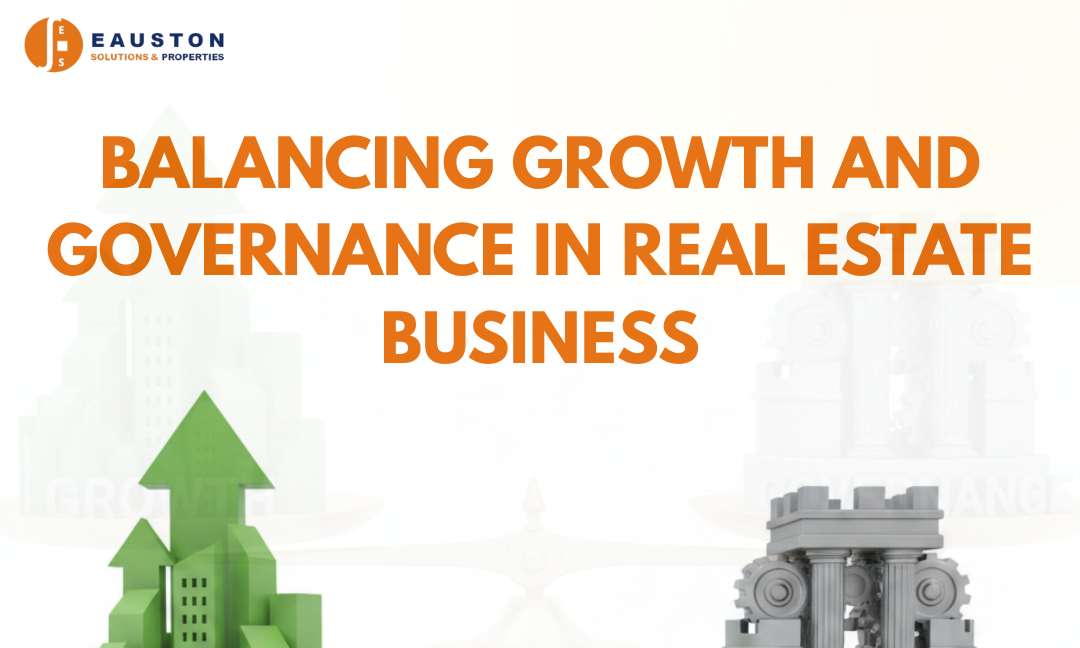
It is important to note that Growth builds scale and Governance builds trust, and that together, they build a lasting real estate brand. The real estate companies that will define Nigeria's next decade won't necessarily be the biggest or the fastest-growing. They'll be those that built strong enough foundations to grow deliberately, smart enough systems to scale sustainably, and robust enough governance to weather inevitable storms.
Growth and governance aren't opposing forces but should be complementary, such that when properly balanced, they create something greater than either could achieve alone: real estate companies built to last.