BY: ONYINYECHI PATRICK FOR: EAUSTON SOLUTIONS AND PROPERTIES
INTRODUCTION
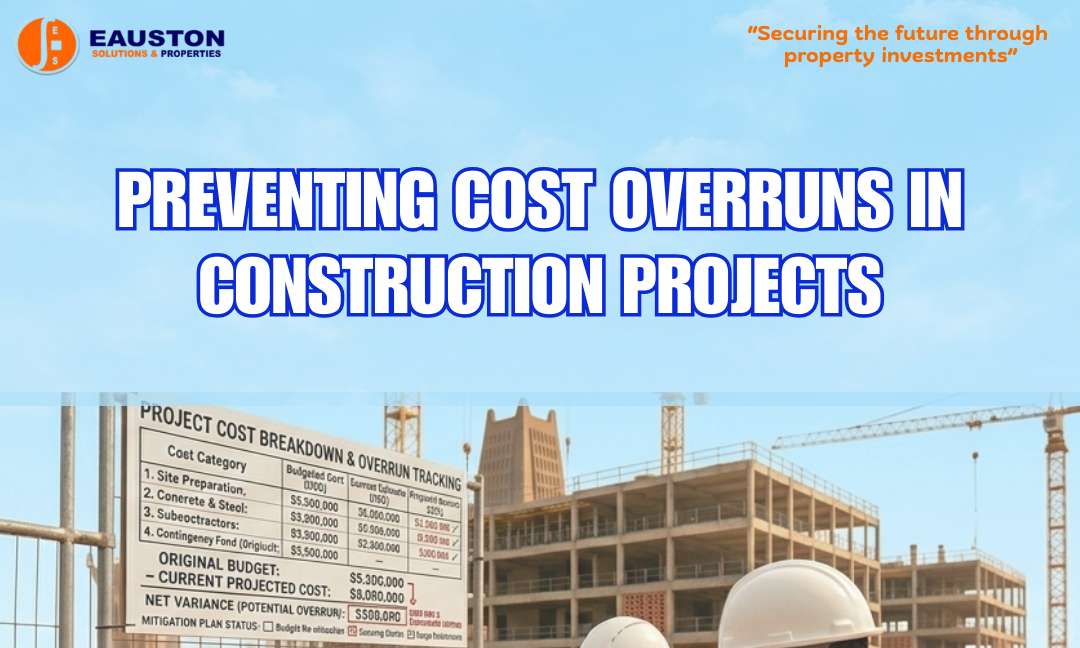
Cost Overruns remain one of the most common and damaging challenges in Construction Projects. They affect Profitability, delay delivery timelines, strain client relationships, and can even halt projects entirely. Whether in residential, commercial, or infrastructure development, controlling project costs requires proactive planning, disciplined execution, and continuous monitoring.
Preventing cost overruns is not about cutting corners; it is about improving accuracy, coordination, and decision-making throughout the project timeframe.
UNDERSTANDING COST OVERRUNS IN CONSTRUCTION
A Cost Overrun occurs when the actual project cost exceeds the original approved budget. While this definition sounds straightforward, the reality is more complex. Cost overruns are usually not caused by a single mistake but by a combination of planning gaps, execution issues, and external factors that compound over time, including inaccurate estimates, design errors, material price fluctuations, poor project management, or unforeseen site conditions.
While some risks are unavoidable, many overruns can be prevented through structured planning and strong control systems. Effective cost management also requires distinguishing between direct budget impacts and indirect resource drains.
TWO (2) CATEGORIES OF COST OVERRUNS
Direct Overruns: These arise from measurable construction cost increases, such as higher material prices, increased labour hours, equipment cost increases, design corrections, and work, etc.
Indirect Overruns: These overruns are cost increases that do not come directly from physical construction work but from supporting activities such as site supervision costs, administrative expenses, legal or dispute-related expenses, etc.
KEY CAUSES OF COST OVERRUNS
- Incomplete or inaccurate cost estimates
- Poor project scope definition
- Frequent design change
- Weak contract documentation
- Inadequate risk assessment
- Poor scheduling and delays
- Material price fluctuations
- Lack of cost tracking and control
EFFECTIVE STRATEGIES TO PREVENT COST OVERRUNS
- Develop Detailed and Accurate Cost Estimates: Prepare estimates using complete drawings, proper quantity take-offs, and current market rates. Involve experienced estimators and include contingency allowances to cover uncertainties. Update estimates as project details become clearer.
- Clearly define project Scope: Document all project requirements, specifications, and deliverables before work begins. A clear scope prevents misunderstandings, rework, and scope creep that can increase cost.
- Implement Strong Change Control procedures: Changes are common in construction, but uncontrolled changes are costly. A formal change management process should include: written change requests, cost and time analysis, approval workflow, and updated budgets and schedules. No change should proceed without documented authorization.
- Conduct Proper Risk Planning: Teams should identify possible technical, financial, and site risks early. Risks like site conditions, regulatory risks, supply chain risks, weather impacts, and market price fluctuations should have a mitigation strategy and budget contingency.
- Improve Procurement Planning: Procurement mistakes can significantly inflate costs. Best practices to improve procurement planning include: plan material and subcontractor procurement early, use competitive bidding, verify supplier reliability, and lock prices where possible to avoid sudden cost increases.
- Enhance Communication and Coordination: maintain clear communication among Clients, consultants, and contractors. Regular progress meetings reduce errors, duplication, and costly misunderstandings.
CONCLUSION
Preventing cost overruns in construction projects requires more than strict budgeting; it demands integrated planning, disciplined controls, risk awareness, and collaborative execution. When cost management is treated as a continuous process rather than a one-time estimate, projects are more likely to stay within budget and deliver expected value.
Organizations that invest in proper cost control systems not only protect profits but also build stronger client trust and long-term credibility in the construction industry.